

Interview with Executive Director Angela Landsberg

Angela
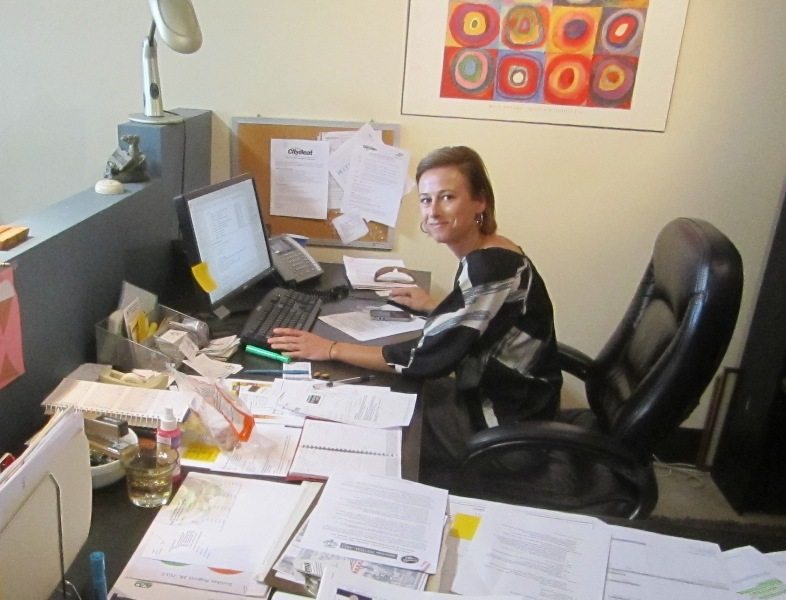
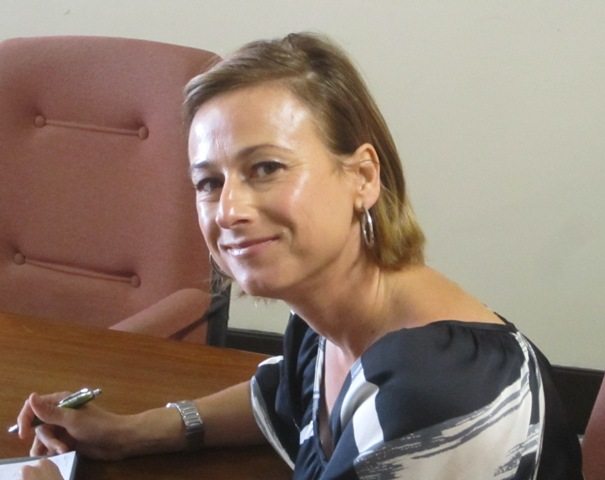
Landsberg, Executive Director, North Park Main Street, outside her
office at 3076 University Ave. (All photos by Frank Gormlie)
“I’ve been to meetings all day,” she declared. “I was out of the office for 3 hours and I now have 62 emails – not junk either – these all have to be responded to,” she said, signing off on her computer. I laughed, and we hugged. I’ve known Angie since she was a teenager, oldest daughter of my ex, and we’d lived together for a couple of years way back in the late Eighties.
And now she was the head of this North Park business group. Actually, North Park – a huge area, in fact, has several business groups, as there’s the El Cajon Boulevard Business Improvement Association, and another one south of Angela’s area. Her North Park Main Street area goes from the Georgia Street Bridge or Florida Street to the west, all the way to the 805 on the east, but it’s only 2 to 3 blocks wide, from Upas to Howard on the north.
 The NPMS has 500 to 600 members, Angela – or Angie – told me. “The
majority are store fronts,” she said. She has a 13 member Board she
works for – all volunteers – and a new president has just taken office,
Cheryl Dye, who is a business owner and consultant.
The NPMS has 500 to 600 members, Angela – or Angie – told me. “The
majority are store fronts,” she said. She has a 13 member Board she
works for – all volunteers – and a new president has just taken office,
Cheryl Dye, who is a business owner and consultant.The association was formed in 1995 when Christine Kehoe was the City Councilmember for the area. And Angie worked for Chris as a Council Representative back then. So she was working out of the council office when NPMS was put together. She had worked for Kehoe – who now is a State Senator – for 3 years back in the mid-Nineties. Angie was hired as executive director in 2011, beating out 102 other applicants.
I asked about funding for the group. About a third of their funding, she told me, comes from the business improvement district assessments. “It’s part of the business tax,” she said, “and it’s based on the number of employees a business has. The cap, I believe, is $500 a year, with the lowest at $125 a year.” Angie was quick to point out that property owners don’t pay into this assessment.
A second third, she said, comes from grants from the City and County – some of which they applied for, some are automatic. They’re very thankful for Todd Gloria, the City Councilmember for the area, and for County Supervisors Ron Roberts, she told me.
 The final third comes from their events, the Festival of Arts, and the Taste of North Park, Angie said.
“Neighborhoods have their own dynamics, their own priorities,” Angie said. “We’re lucky because our business district is just one neighborhood.” Some business districts straddle several communities, she added.
I asked Angie if she agreed with Councilmember Gloria’s assessment that North Park is in a 15-year renewal era. She does. She added:
“I’m a conduit to the City Council office – a way to get information out to the members. And hopefully,” she said, “I bring valuable information to Todd Gloria.” She meets with Gloria quarterly, and works very closely with his staff. The rep for the area is Anthony Bernal.
Asking for an example of how this plays out, Angie responded by describing how she looked at the streets surrounding the North Park Farmers’ Market, held at Herman Street and University. This was an area that they promote and take people over to show. But, she added, “I noticed the street in real disrepair. I took photos, and sent them to Bernal,” the council rep,” to see if they do something about the repairs.” And they did – Todd Gloria’s office did respond and facilitated repairs to the street.
“These are the types of things we do for our businesses,” Angie said. She cited another example:
“One of our businesses – a restaurant
/ bar – was notified that the water bill hadn’t been paid by the
building owner, and the water was about to be shut off. I made a call
to Anthony [Bernal of Gloria's office] – the business would be out of
business. Boom. The water got turned on by the end of the day.”
“Todd is very responsive to the community,” she added.
Angie then launched into describing the three main things the business association does.
The first is business advocacy. “We respond to business problems, and carry their interests downtown,” Angie said.
Secondly, they take care of the area, and its infrastructure. The street trees and their grates, the street furniture, the lights. “Things that involve the quality of life,” she said. They don’t have a maintenance district, and Angie said they’d like to see more lights and trees and street furniture.
Thirdly, Angie talked to me about the business recruitment and business retention her group does. She helps businesses stay in the area. “We had a business recently who started talking about the lack of business.” Angie asked them if they used social media, like having a facebook page for their business. They didn’t. So she hooked them up with another local business who did social media, and their clientele increased.
For another example, Angie said:
“I made a trek out to Mission Hills
to a Mexican food restaurant that was rumored to want to move to North
Park. I gave him my card and and gave him a tour of the area.”
Angie told me she really likes working on “policy stuff.” Recently, she got involved in the sidewalk cafe policy, made many phone calls, and made it easier in the short run for cafes to utilize more of the space surrounding their establishments.
 Another issue for her when she first took on the position, was that
she found out that banks don’t pay the assessment tax, and she
discovered that they don’t pay a city business tax, as they are
state-licensed businesses. “Why shouldn’t a bank pay the assessment,
when the mom and pop storefronts with a couple of employees have to?”
There’s four banks in her area of North Park – so, this is an issue she
is involved in still.
Another issue for her when she first took on the position, was that
she found out that banks don’t pay the assessment tax, and she
discovered that they don’t pay a city business tax, as they are
state-licensed businesses. “Why shouldn’t a bank pay the assessment,
when the mom and pop storefronts with a couple of employees have to?”
There’s four banks in her area of North Park – so, this is an issue she
is involved in still.
Bicycle tire pumps, ready for the Bike Corrals.
“The City is doing a North Park plan update,” Angie said, “and it’s almost done. The last one was done in 1986.”
“I know the framework that people
have worked for here for 15 years … to 25 years, and it’s not corporate
franchises,” Angie stated emphatically.
A couple of big things she wanted to share came next.
They’ve just received a $25,000 grant from Supervisor Ron Roberts for bike corrals in North Park. “A bike corral,” she explained, “is where we take 2 parking spaces on the street and create bike spaces. They’ve done this in front of The Linkery” she said, giving an example of a bike corral already set up.
The other big news is that NPMS has received grants from the State Office of Historical Preservation and from SDG&E and from the San Diego Green Building Council to set up San Diego’s very first “Eco-District”. “Like the one in Portland [Oregon]” she told me.
They’ll be hiring 2 part-time staff, to assist the project in its beginning stages. “We’ll create a consciousness,” she said, “and implement best practices for sustainability.”
What will the Eco-District look like? I asked.
The Main Street might implement a community composting process, where the restaurants and stores contribute to a neighborhood compost, usable by residents and some businesses. They’ll increase recycling receptacles; they’ll advocate for more areas that are suitable for walkability – less of an “auto-centric” environment.
“We’ll look for more funds for ‘bike corrals’; one is installed, and two more are going in,” she said. “This has never been done before,” Angie said proudly. “It will be the first of its kind,” and added that the eco-district should be up and running by June 2013. They’ll have a website to provide resources to businesses with sustainability practices. “We will calculate the carbon footprint of the businesses, and mitigate it.”
Another idea Angie discussed is the concept of a “parklet”, which is taking a dedicated parking in the right-of-way – two parking spaces, and install a park-like setting in that space, with plants, trees, and furniture.
North Park Main Street is sponsoring the first such parklet in San Diego, in front of Cafe Calabria. This pilot project got its boost after 35 hours of meetings, Angie told me.
At this point, I began just throwing issues out at her, to get a response.
Utility boxes? This is a big issue for her president, Cheryl Dye, Angie said. They’re trying to get the City to give them some support, as right now the California Public Utility Council has not agreed to even discuss the issues.
“Utility boxes are just plunked down without any rhyme or reason. You could show up in front of your business some day,” Angie said, “and there would be one. And no one would have to notice you.”
Liquor licenses? Angela drew a deep breath.
“It’s a complicated issue that needs
to have lots of parties involved in order to deal with it. It involves
the state – the state issues the liquor license; it involves the City
because the City Vice is involved; the public weighs in on licenses, and
then there’s the whole balance of licenses with the community.”
“Closing time at 2 am is a big
issue. All licenses have different conditions, some are for full bars,
some for restaurants that serve beer and wine.” She talked about the
impact that all these licenses have upon the community. “The 2 am bar
that serves no food has a different impact on the community than a
restaurant that serves beer and wine and closes at 11. But all of them
have to apply for a liquor license and be subject to the community
protests. They’re all subject to the same process,” she added.
“The issue is with ABC, because they
are the agency that determines the licenses that go into a census
tract.” She continued, “we work closely with ABC and work closely with
Vice.”
On another front, Angie said, there’s four communities most impacted by bars and the consumption of alcohol. North Park, Hillcrest, the Gaslamp, and Pacific Beach. The four just had their first meeting with Vice and ABC, and she cited the remnants of a group called RADD – Rockers Against Drunk Driving. “These are communities interested in making the practice of responsible drinking one of the things we do.”
The University Avenue make-over? The remainder will be completed, she told me, in Fiscal Year 2017.
Her organization only has jurisdiction in its district, so issues, problems on El Cajon Blvd don’t involve her directly.
Closing streets for the August 18th big bicycle event. She said the mayor’s office is doing a lot of outreach in the communities right now. They have a member on the committee or task force coordinating it. “We hope they use the commercial district as a bike route,” she said.
Trolleys on University? Mayor Filner had discussed this idea with her, but it was just that – discussion.
On the issue of public transportation, she meets regularly, she said, with MTS.
Angie told me she’d like to be able to pursue an MBA in non-profit administration, taking courses at night. She likes the program offered by USD. She loves this job, she said. She doesn’t have the Sunday night ‘willies’ – that anxiety that some have about the next work day.
As our interview drew to a close, I knew she has two girls, Madeline and Sara, 9 and 11, waiting for her at home in Golden Hill. I gathered up my notes and camera, we hugged and embraced and promised to see each other real soon.
As I was driving out of North Park towards 805, I passed by The Linkery. And there was a woman taking photos of the “bike corral” on the street next to the restaurant. Maybe it works, I thought to myself. Renewal and revitalization of old neighborhoods like North Park can and does work. And Angela Landsberg is in the thick of it – and North Park is lucky to have her, I thought, as I glided my vehicle onto the freeway going south.
No comments:
Post a Comment